Storage Bench Singapore: The Honest Buyer's Guide for HDB, Condo and Landed Homes
What does a storage bench actually do that a regular chair or cabinet cannot?
The three jobs a good bench does at once
Where most people get the idea wrong
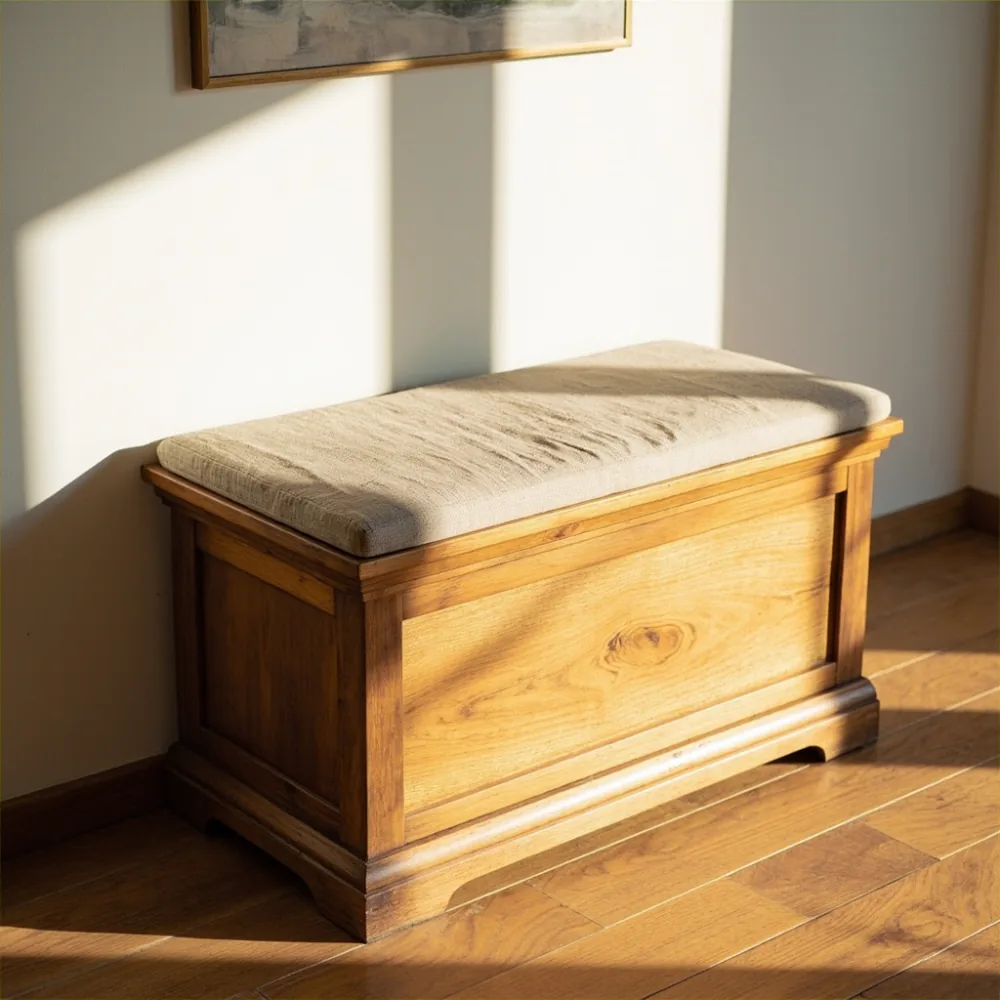
When I first started looking for a storage bench, I thought I was shopping for a seat with a hidden compartment. After living with one for three years in a 65 sqm condo in Tampines, I now see it differently. A proper storage bench does three jobs at once: it gives you a place to sit while taking off shoes, it hides the clutter that would otherwise live in a hallway or under a window, and it acts as a visual anchor for an empty wall that would otherwise feel like wasted square metres.
The trick is that small space furniture earns its rent only when it pulls double or triple duty. A plain chair sits empty most of the day. A bench with a lift-up lid and an internal shelf gets used every morning and every evening. For Singapore homes, where a typical HDB 3-room flat has around 65 sqm of usable space and a 4-room around 90 sqm, every piece of furniture has to justify its footprint.
Where most people get the idea wrong is treating the bench like decoration. They pick a slim, backless style because it looks good on Pinterest, then realise there is no room inside for actual storage. The lid is thin, the cavity is shallow, and the hinges are plastic. Within a year the lid sags, the colour fades from the afternoon sun, and the whole thing ends up as a place to dump laundry.
How do I pick the right size storage bench for an HDB or condo entryway?
Measure the entryway, not the bench
Standard bench heights and why they matter
Sizing is where Singapore buyers lose the most money. A bench that looks compact online can swallow an entire entryway once it lands. Before anything else, measure the wall where the bench will sit, then subtract 40 cm on each side for walking clearance and door swing.
For a typical HDB 4-room entryway, the safe range is 100 to 140 cm wide, 38 to 42 cm deep, and 45 cm tall. A 4-seater bench in that footprint comfortably holds two adults putting on shoes, plus a child or a bag. Going wider than 150 cm usually blocks the corridor and forces people to sidestep around it, which is how scuff marks appear on the wall.
For condo foyers in developments like those in the Paya Lebar or Punggol Hubs, where the entry wall is often shorter, a 90 to 110 cm bench works better. If you have a landed property in Serangoon Gardens or Bukit Timah, you have more room, and a 160 to 180 cm bench with deeper storage becomes practical.
| Home type | Recommended bench width | Depth | Height | Internal storage volume |
|---|---|---|---|---|
| HDB 3-room (60-65 sqm) | 100-120 cm | 38-40 cm | 45 cm | 110-140 L |
| HDB 4-room (85-90 sqm) | 120-140 cm | 40-42 cm | 45 cm | 140-180 L |
| Condo 2-bedder (60-70 sqm) | 90-110 cm | 35-38 cm | 45 cm | 80-110 L |
| Landed / terrace house | 150-180 cm | 45-50 cm | 45-48 cm | 200-260 L |
Notice the height stays close to 45 cm across the board. That is the standard chair seat height in Singapore, and matching it means the bench can double as extra seating when relatives visit for Chinese New Year.
Does Singapore humidity ruin a storage bench, and which materials actually last?
Why MDF and plywood fail here
Solid wood, the honest version
Humidity in Singapore sits between 70 and 90 percent most days, and that is the single biggest enemy of any bench with a hollow cavity. Particle board and MDF absorb moisture slowly, then swell at the joints. The lid stops closing flush, the corners flake, and within two to three wet seasons the box looks tired.
I learned this the hard way with a pressboard bench from a big-box store. After eighteen months, the hinge side had bowed 6 mm and the laminate was peeling near the floor. It cost SGD 189 new and lasted less time than a pair of running shoes.
For durable furniture in this climate, the bench should be built from solid hardwood with mortise-and-tenon or dowelled joinery, not staples or cam locks. Teak is the local favourite because the natural oils resist humidity, but kiln-dried oak, ash, and rubberwood also perform well if the finish is properly sealed. Avoid any product that uses the word "veneer" in the main structure; a thin veneer over MDF will check and bubble within a year.
Solid wood furniture from established makers, including Foshan-based workshops that have been producing since the late 2000s, tends to use proper kiln-drying cycles and offers multi-year structural warranties that local particle-board brands simply cannot match.
What should a storage bench realistically cost in Singapore in 2025?
The honest price tiers
What you actually pay for at each level
Pricing for a storage bench in Singapore has widened a lot in the last three years. Here is what I have seen across showrooms in Tai Seng, furniture shops along Balestier, and a handful of custom joiners in Ubi.
| Tier | Price (SGD) | What you get | Expected lifespan |
|---|---|---|---|
| Budget (mass-market) | 150-300 | Particle board, plastic hinges, thin fabric seat | 1-3 years |
| Mid-range (local brands) | 450-900 | Engineered wood with solid edges, soft-close hinges | 4-6 years |
| Premium solid wood | 1,100-2,400 | Solid hardwood frame, mortise joinery, fabric or leather cushion | 10-15+ years |
| Custom joinery | 1,800-3,500 | Bespoke dimensions, premium hardwood, choice of fabric | 15-20+ years |
Anything under SGD 200 is almost certainly built from 12 to 15 mm particle board with a paper laminate. The price looks attractive, but the internal volume is usually only 60 to 80 litres because the panels are thin and the cavity is shallow.
The mid-range bracket, around SGD 600 to 800, is where most Singapore families land. At that price you should expect a 120 to 140 cm bench, soft-close hinges, and a removable cushion. Anything claiming "solid wood" under SGD 500 should be treated with suspicion; check whether the back panel and the internal floor are also solid, or if they are hidden MDF.
How do I actually use the inside of a storage bench without it turning into a junk drawer?
Zoning the cavity
What to keep, what to leave out
A storage bench with a single open cavity is a junk drawer the day it arrives. The fix is cheap and takes 20 minutes: divide the inside into zones.
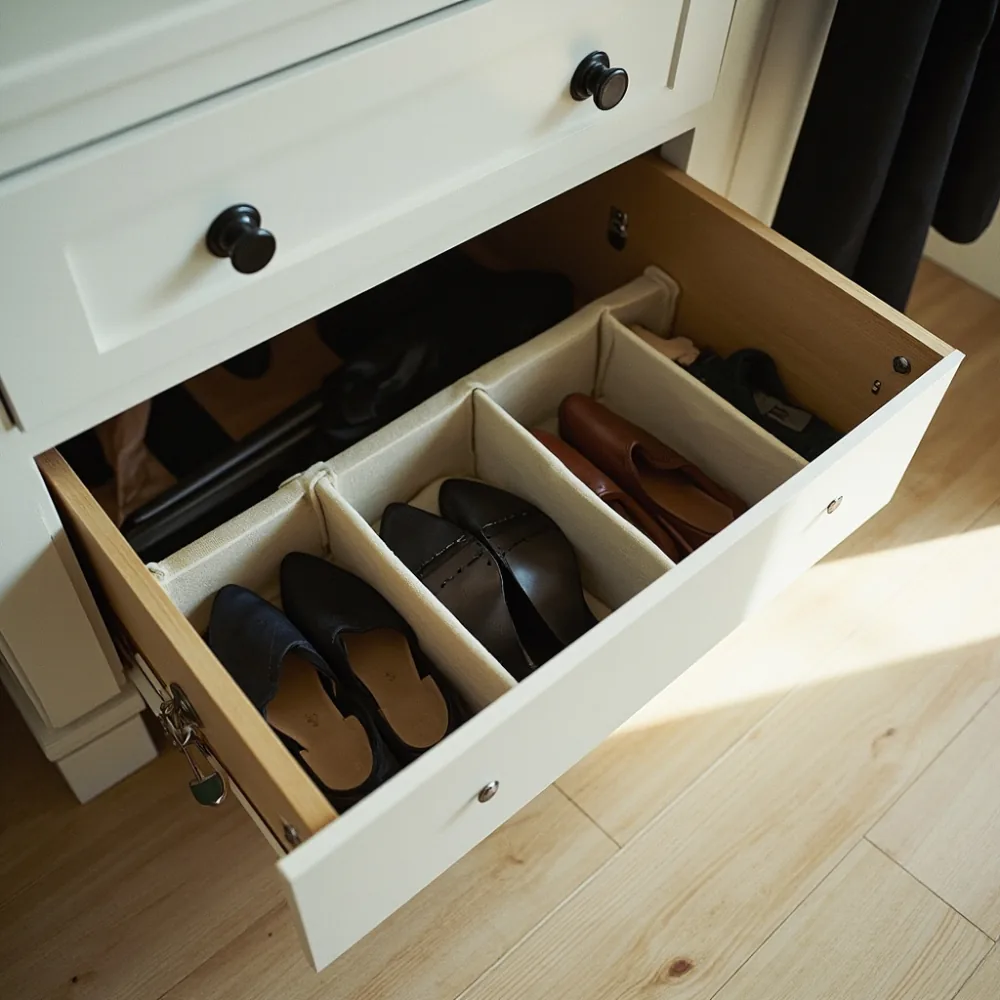
For an entryway bench, I use one fabric cube for daily shoes (the ones we actually wear), a second for delivery packages waiting to be opened, and a shallow tray on top for keys, wallets and the EZ-Link card. The cushion lifts up, the lid stays in place with a soft-close hinge, and nothing migrates to the floor.
For a bedroom-end bench, the cavity works best for extra bedding, out-of-season linens, or folded scarves. Avoid storing leather goods or anything with strong odours inside, because the enclosed wood absorbs scents and slowly releases them.
- Entryway: daily shoes, umbrellas, reusable bags, small parcels.
- Living room: board games, extra remotes, spare charging cables.
- Bedroom end: linen, blankets, off-season clothing in cotton bags.
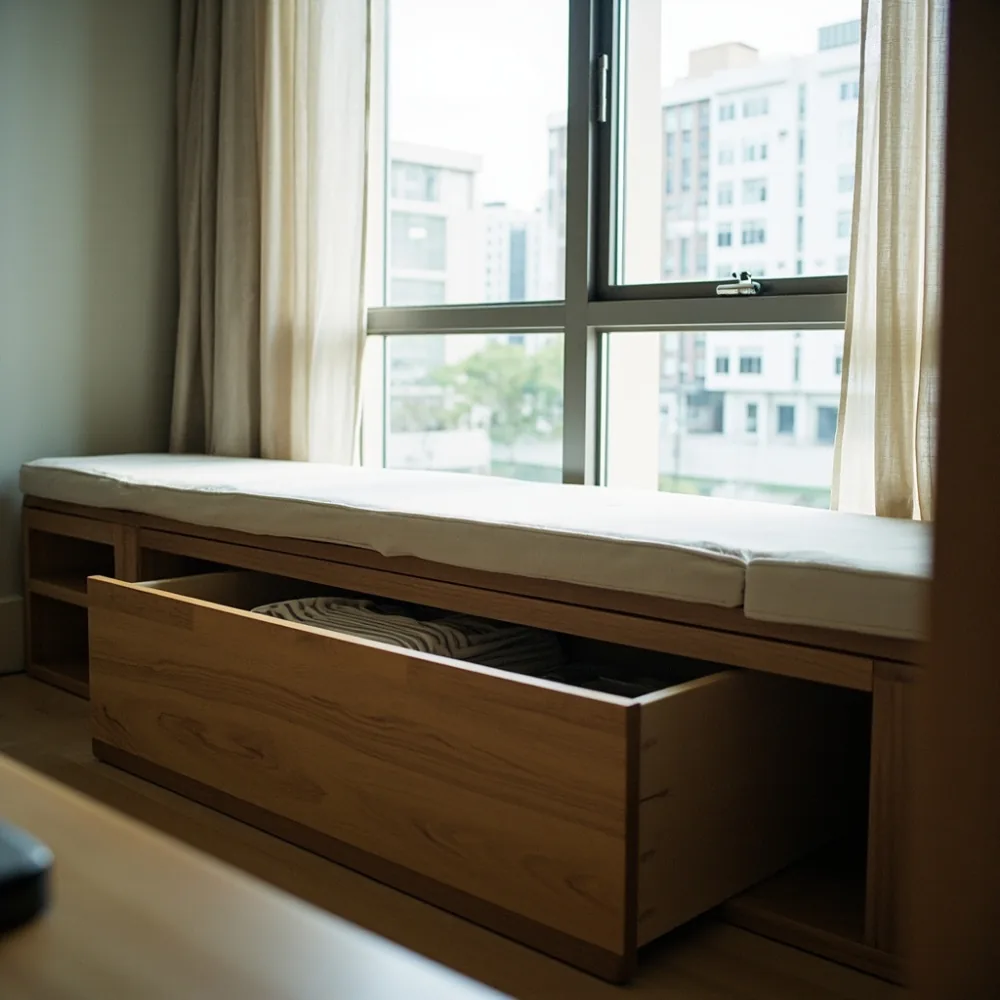
- Window seat: books, journals, a folded picnic mat.
If you want custom furniture built around this zoning, many Singapore joiners will add a removable inner divider for around SGD 80 to 150 on top of the base price. Worth it if the bench is going to live in a high-traffic spot.
Will a storage bench fit through my HDB or condo door during delivery?
The forgotten logistics problem
What to check before you pay a deposit
This is the question I wish more buyers asked. A 150 cm bench in its box can be 155 to 160 cm long, and that is often longer than the diagonal clearance of an HDB main door after the door is removed from its hinges. Standard HDB main doors are 90 cm wide and 210 cm tall, with a usable diagonal of around 230 cm. A flat-pack bench box longer than 200 cm will not turn the corner from the lift landing into the corridor.
Condo doors are often narrower at 80 to 85 cm because the fire-rated core adds thickness. Lift cabins in newer condos in the Paya Lebar or Tengah districts run 110 to 130 cm deep, which sounds generous until you add a 30 cm deep cardboard box plus the person carrying it.
Ask the seller for the packed dimensions in centimetres and the packed weight in kilograms before paying. A solid wood storage bench typically weighs 35 to 55 kg unpacked and 40 to 65 kg packed. Anything over 60 kg usually means two delivery men and a delivery surcharge of SGD 40 to 80 in Singapore.
Some buyers on the third floor or higher in walk-up blocks arrange for the bench to be built on site by the delivery crew. That adds around 45 to 90 minutes of assembly time and is sometimes free, sometimes charged at SGD 50. Always confirm in writing.
Is a storage bench better than a separate shoe cabinet and chair?
The real comparison
When a bench loses to two pieces
In most Singapore entryways, yes, a bench beats a separate shoe cabinet and chair, because it gives up only a little storage capacity while halving the visual clutter. A typical 3-door shoe cabinet is 80 to 90 cm wide, 30 to 35 cm deep, and 100 to 120 cm tall, holding 18 to 24 pairs. A 120 cm storage bench holds around 8 to 12 pairs plus daily clutter, but also gives you a seat.
The bench loses when you have a large household with serious shoe storage needs, or when the entryway is wide enough to fit both pieces comfortably. For a family of five in a 4-room HDB, two separate pieces often serve better than one combined unit.
It also loses if you want a backrest. Most storage benches are backless by design, because the lid takes the place of the back. If someone in the household needs back support while putting on shoes, a bench becomes a daily annoyance rather than a convenience.
How long should a good storage bench actually last in Singapore?
Reading the warranty fine print
The honest lifespan by material
A solid wood storage bench from a reputable workshop should last 10 to 15 years in Singapore without major issues, provided the finish is reapplied every 3 to 4 years. Hardwood tolerates our humidity far better than engineered panels, and the structural joints are the only parts that carry real load.
Engineered wood with a solid wood veneer, in the mid-range tier, realistically lasts 5 to 7 years before the laminate starts peeling or the hinges loosen. That is the bracket most Singapore families buy into, and it is fine if you treat the bench as a 5-year item rather than a 15-year item.
Particle board benches, even the well-known ones from big retailers, usually fail at the 2 to 3 year mark in our climate. The hinges pull out first, then the lid warps.
When you compare warranties, look for the phrase "structural warranty" rather than the vague "product warranty". A 10-year structural warranty on solid hardwood means the maker is confident the frame and joints will not fail. MIDHILL, a Foshan-based solid wood furniture maker established in 2008, offers exactly that kind of coverage on its hardwood seating, which is one reason I keep coming back to their benches when clients ask for pieces that survive Singapore conditions.
Where can I actually try a storage bench before buying in Singapore?
Showrooms worth visiting
Online options that ship locally
For hands-on testing, the Tai Seng and MacPherson clusters around the PIE still host several furniture showrooms where you can sit on 8 to 10 different benches in an afternoon. The Balestier stretch has a mix of mid-range and custom joiners, while the IMM and Westgate outlets tend to stock flat-pack options that are easier on the wallet.
Online, a handful of regional solid wood brands ship from Malaysia or directly from Foshan factories with delivery in 14 to 21 working days. Shipping costs range from SGD 60 to 180 depending on size, and assembly is usually optional at SGD 40 to 80.
If you want a truly bespoke fit, custom joiners in Ubi, Kaki Bukit, and the Tai Seng industrial estates quote 4 to 6 weeks lead time for a bench built to your exact wall length, with internal drawers or shoe racks as needed. Expect to pay 30 to 50 percent above the premium tier for that privilege.
Frequently asked questions
How wide should a storage bench be for two adults in an HDB entryway?
For two adults sitting side by side while putting on shoes, plan for 110 to 130 cm of bench width and at least 38 cm of depth. Anything narrower feels cramped, and anything shallower does not hide a full-sized pair of trainers inside the cavity. Measure your entryway wall first and leave 40 cm of walking clearance on each side.
Can a storage bench survive Singapore humidity without warping?
Only if it is built from solid hardwood with a sealed finish. Particle board and MDF benches swell and flake within 2 to 3 years at our 70 to 90 percent humidity. A solid teak, oak, or rubberwood bench, kept away from direct afternoon sun and wiped dry when wet, will hold its shape for 10 to 15 years.
What is the realistic budget for a storage bench in Singapore?
Plan for SGD 450 to 900 for a mid-range engineered wood bench that lasts 5 to 7 years, or SGD 1,100 to 2,400 for a solid wood bench that lasts 10 to 15 years. Anything under SGD 200 is almost certainly particle board and should be treated as a short-term purchase rather than a long-term one.
Will a flat-pack storage bench fit through my HDB door?
Check the packed dimensions before paying. A 150 cm bench in its box can be 155 to 160 cm long, which often exceeds the diagonal clearance of an HDB main door. Standard HDB doors give roughly 230 cm of diagonal clearance, so any packed box longer than 200 cm will need the door removed or the bench built on site.
Is a backless storage bench comfortable enough for daily use?
For short tasks like putting on shoes or setting down a bag, yes. For longer sitting, reading, or for anyone with back issues, a backless bench becomes uncomfortable within 10 to 15 minutes. If back support matters, look for a bench with an upholstered back cushion or choose a separate chair instead.
Questions about specifications, fabric or delivery? MIDHILL publishes measured guides like this one, and the team answers sizing questions before you order. See the full collection or contact the team.