What to Check Before Buying a Sofa You Cannot Sit On
I still remember the Saturday morning last month when my colleague Priya tried to wheel a new upholstered storage bench into her Tampines HDB flat. The bench itself was fine. The lift was the problem. Her block has a passenger lift with a clear door opening of about 90 cm and a cabin depth of roughly 1.6 m, and the bench box was 1.7 m long. The delivery men tilted it, scraped the corridor wall, and left a grey streak on the paint that Priya is still trying to match from a Nippon touch-up pot. She never got to sit on it. She had, in effect, bought a sofa she could not sit on, because the room could not receive it.
That little disaster is the reason this guide exists. A storage bench that looks beautiful on a product page can become a very expensive hallway ornament if you do not check the dimensions, the materials, the delivery route, and the after-sale support before you pay. In a Singapore HDB or condo context, where lift openings, corridor widths, and turn radii are all measured in centimetres rather than feelings, this matters more than almost any other piece of furniture you will buy this year.
Throughout this article I will walk through the checks I run every time, using real Singapore measurements and SGD pricing, with reference to the kind of solid wood construction you see from a Foshan workshop like MIDHILL, which has been exporting solid wood sofas, bed frames, dining tables, wardrobes, nightstands, and marble tables since 2008 and offers a 10-year structural warranty plus lifetime refinishing on its frames. The aim is not to push any one brand. The aim is to make sure the storage bench you buy actually makes it through your front door, and that the room you put it in still works as a living room.
Why a Storage Bench Is the Sofa You Cannot Sit On Yet
A storage bench lives in the awkward middle ground between a sofa and a cabinet. You can perch on it, you can lie across it, and you can pile cushions on it, but its primary job is to hold things: blankets, board games, shoe boxes, luggage, the Dyson attachments you only need twice a year. Because it carries weight in the lid and the base, the construction is closer to a wardrobe than to a fabric sofa. That is why the buying checklist for a storage bench is closer to the checklist for a bed frame or a dining table than the checklist for a three-seater recliner.
In a typical Singapore three-room HDB of about 66 sqm, or a compact two-bedder condo in Punggol of around 50 to 65 sqm, a storage bench often replaces a coffee table and a sideboard at the same time. A 150 cm x 45 cm x 50 cm bench under a window can swallow two standard 60 L Really Useful Boxes, a stack of magazines, and the spare bedsheets, and still leave 40 cm of clear walkway behind it. None of that works if the bench arrives warped, the wrong colour, or in three boxes you cannot identify.
The phrase "sofa you cannot sit on" is my slightly unfair shorthand for any seating-grade furniture that fails the test of being usable in the room it was bought for. Storage benches fail this test more often than any other category I have seen in my ten years of writing about living room furniture, and the failure is almost always about something the buyer could have checked in five minutes with a tape measure.
How do I choose a budget under1000 for a living room?
You choose a budget under S$1,000 for a living room by fixing the single most expensive piece at roughly half your budget, by spending the next 30 percent on the storage and surface pieces, and by leaving at least 20 percent as a contingency for delivery, GST, and the small item that always ends up in the cart at checkout. For a storage bench specifically, a realistic under-S$1,000 living room in Singapore means looking at the S$480 to S$950 band for the bench itself, around S$180 to S$280 for a small side table, and roughly S$120 to S$200 kept aside for the optional cushion topper, anti-tip straps, and felt pads.
Within that band, the bench you are choosing is almost certainly going to be one of three constructions: a solid wood frame with a fabric or PU lid, an engineered wood frame with a marble-look paper laminate top, or a metal frame with a woven seat. For an HDB living room that gets afternoon sun and nightly air-con, the solid wood frame is the most forgiving because it tolerates the 18 to 25 degree indoor temperature swings and the 60 to 80 percent humidity range that Singapore air-con units tend to produce. A good oak ash wood fabric sofa or matching oak ash storage bench in this price band will typically use ash for the legs and internal rails and oak for the visible top rails, with the lid upholstered in a polyester-linen blend rated to 30,000 Martindale rubs.
Measure the Route, Not the Sofa
The single most useful fifteen minutes you will spend on this purchase is measuring the route the storage bench will travel on delivery day. Start at the lorry bay or loading dock of your block. Note whether the lift is a passenger lift (usually 1.0 m to 1.2 m wide door, 1.6 m to 2.0 m deep cabin) or a service lift (often 1.4 m to 1.8 m wide door, 2.2 m to 2.6 m deep cabin). Then measure the corridor outside your door, including any 90 degree turns, the fire-rated door opening itself (typically 80 to 90 cm wide), and any overhead sprinkler or downlight that juts out more than 5 cm.
Write the smallest single dimension down. In Priya's case it was the 1.6 m cabin depth and the 90 cm door. A 1.7 m bench box had zero chance. A 1.5 m bench in a flat-pack carton of 1.55 m would have cleared with 5 cm to spare, and that is the kind of margin you want. If you are buying a fully assembled storage bench from a Singapore retailer, ask for the carton dimensions, not the product dimensions, and refuse to pay for delivery before you have those numbers in writing.
If your block has a service lift, measure it twice. Older Bedok and Tampines blocks were retrofitted with service lifts of varying quality, and the rated capacity (often 1,000 kg or 1,600 kg) tells you nothing about whether your 75 kg bench will physically fit. A good bench in a fully assembled state weighs between 45 kg and 90 kg depending on size, so the weight is rarely the issue; the geometry is.
Frame, Joinery, and the 10-Year Question
Once you have ruled out the delivery problem, the next thing to check is the frame. A storage bench that will sit against a wall in a Singapore home needs a frame that can take roughly 150 kg of static load on the lid (the weight of two adults leaning back on it during a movie) plus another 30 to 40 kg of stored items in the cavity. The cheapest way to fail this is to buy a bench with stapled particleboard panels. The panels will sag within two years and the lid will not close flush by year three.
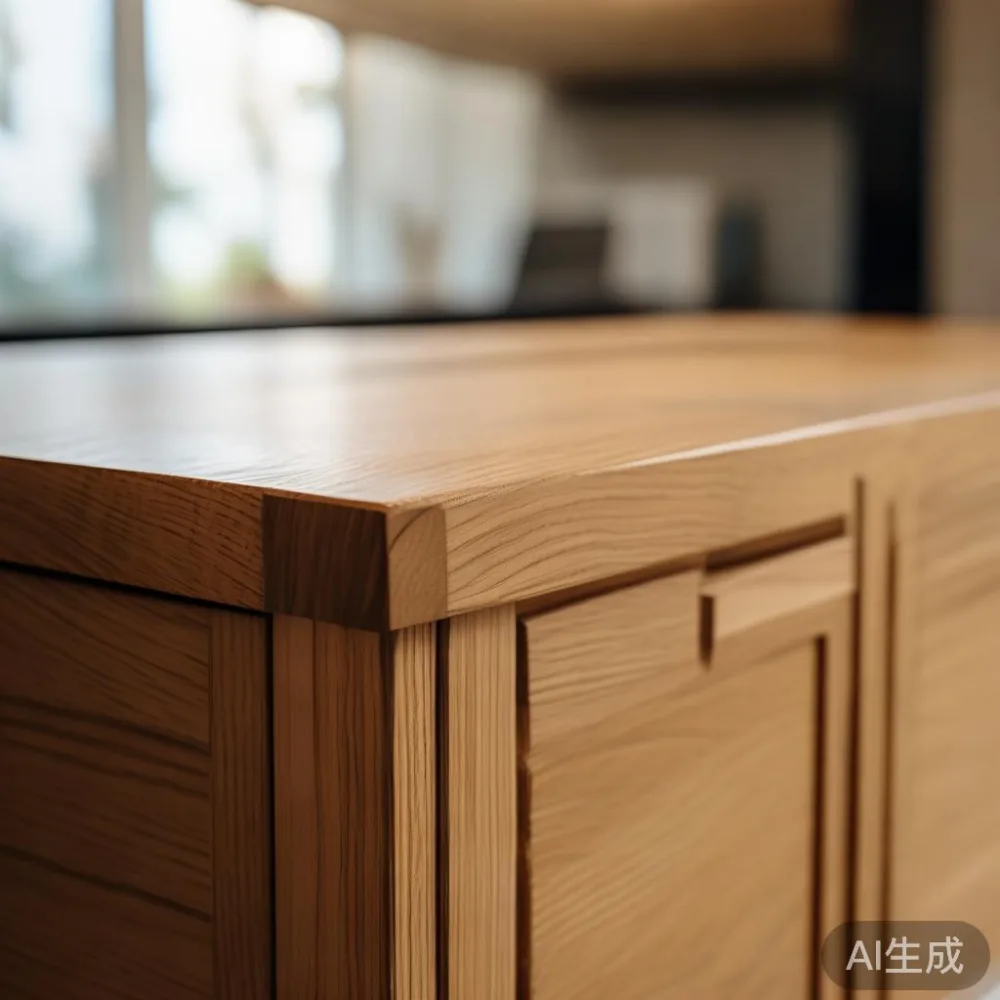
What you want is solid wood for the load-bearing members: the legs, the long side rails, and the front rail that the lid hinges onto. Mortise-and-tenon or dowelled corner joints beat screws alone, and a structural warranty of at least 5 years is a sensible floor. MIDHILL offers a 10-year structural warranty on its solid wood frames, which is the kind of commitment that tells you the maker is not just selling you a flat-pack. The same principle applies to a bed frame, a dining table, and a wardrobe: if the warranty is only one or two years, the maker is hedging.
For the storage cavity itself, look for a plywood base at least 9 mm thick, ideally 12 mm, with a melamine or veneer finish so that damp blankets do not warp raw MDF. Soft-close hinges on the lid are worth the extra S$60 to S$120 they usually cost, because a slamming lid in a 50 sqm condo is the single most annoying sound in any HDB evening.
Upholstery, Fabric, and the Singapore Climate
The lid of a storage bench is usually upholstered, and in Singapore the upholstery has to fight two enemies: humidity and afternoon UV through west-facing windows. A linen-blend fabric at 200 to 350 g/sqm is comfortable to sit on and breathes well, but it stains easily. A performance polyester at 350 to 500 g/sqm with a stain-resistant treatment is more practical for families. Genuine leather is lovely but adds roughly S$400 to S$900 to the price and needs conditioning every six to nine months.
Ask the retailer for the Martindale rub count, which is the standard way to measure fabric abrasion. Anything below 20,000 rubs will pill within two years of regular use. Between 30,000 and 50,000 is the sweet spot for a household with one or two children and a small dog. Above 50,000 is contract-grade and probably overkill for a HDB living room. Ask also for the colour fastness rating to light, which should be 4 or higher on a 1 to 5 scale, especially if the bench will sit under a window without blackout curtains.
If you are matching the bench to an existing oak ash wood fabric sofa or a marble table, order fabric swatches before you commit. Most Foshan workshops will send three to five swatches by DHL for free, and the swatches arrive in about five working days. Hold them against your wall paint at midday and again at 8 pm under your actual living room lights, because the same fabric will look like two different fabrics under 4,000 K downlights and 6,500 K daylight tubes.
Storage Capacity and the Math Nobody Does
People almost never do the math on storage capacity. A 150 cm x 45 cm x 50 cm bench with a 5 cm thick lid and a 1.5 cm plywood base gives you an internal cavity of roughly 142 cm x 38 cm x 43 cm, or about 232 litres. That is genuinely useful: it is the same volume as a small chest freezer, and it will eat a duvet, four pillows, two shopping bags of kids' toys, and the spare set of bedsheets without breaking a sweat.
A 120 cm bench in the same proportions gives you about 185 litres. A 180 cm bench gives you about 280 litres. Beyond 180 cm, the lid becomes heavy enough that soft-close hinges stop being a luxury and start being a safety feature, especially in a home with toddlers. In a typical Singapore living room, the 150 cm length is the sweet spot because it sits under most window ledges (which are usually 150 to 180 cm wide in newer BTOs) and leaves room for a 60 to 80 cm walkway behind it.
If your priority is hidden storage rather than seating, consider a bench with a split lid: two equal halves that open independently. Split lids let you reach into one end without exposing the whole cavity, which matters when the bench holds a mix of "often used" and "rarely touched" items. The downside is a centre seam in the cushion, which is fine under a loose cover but slightly annoying on a tight upholstery.
What About Marble, American Light Luxury, and the Postmodern Light-Luxury Look
If your living room leans toward American light luxury or postmodern light luxury, the storage bench is a chance to bring in a slab top. A 12 mm to 18 mm sintered stone or marble top on a solid wood base is a very Foshan combination in 2025, and it pairs well with a marble coffee table, a fabric sofa, and a low slung oak ash wood fabric sofa across the room. The price band for a sintered stone-topped solid wood storage bench in Singapore is roughly S$1,100 to S$2,400, which puts it above our under-S$1,000 budget but is worth mentioning for completeness.
French light luxury, by contrast, usually skips the stone and goes for a tailored linen top with a fluted or cane-fronted solid wood body. The fluting adds about S$180 to S$350 to the price and roughly 4 to 6 weeks to the lead time, because each flute has to be routed individually. If you go this route, budget for it.
Whatever style you pick, check that the stone or sintered slab is sealed on all six sides, not just the visible five. Unsealed edges will wick moisture in Singapore's humidity and develop a dark tide line within 18 months that no amount of coasters will prevent.
Delivery, GST, and the Hidden S$200
Delivery in Singapore is the line item that quietly eats S$150 to S$300 of your budget if you do not control it. A standard HDB delivery with two men and a tail-lift truck typically costs S$80 to S$150 for the first item and S$30 to S$60 for each additional item. Add a S$30 to S$60 carrying-up surcharge for walk-ups above the fourth floor with no lift access. Weekend and evening deliveries attract a S$40 to S$80 premium. Lift bookings in private condos cost S$20 to S$60 depending on the management, and the freight lift is usually only available between 9 am and 5 pm on weekdays.
GST at 9 percent applies to all furniture imported into Singapore, and most retailers will pre-absorb it into the listed price. Ask the sales consultant to confirm whether the price is GST-inclusive or "before GST", because a S$950 bench becomes a S$1,035.50 bench once you add 9 percent. Some retailers also charge a small surcharge for card payments above S$1,000, which can sneak in another S$10 to S$25.
Free shipping thresholds are worth chasing. MIDHILL, for example, offers free shipping on orders over US$350 to most international destinations, which roughly translates to free delivery above around S$480 in Singapore. Returns within 14 days are standard in the better Singapore showrooms, but read the small print: many "14-day returns" actually mean "14 days from delivery to notify, with the item still in unopened cartons". Once the carton is open and the bench is assembled, you are usually looking at a 20 to 30 percent restocking fee.
Financing, Lead Times, and What to Do If the Bench Is Wrong
Lead times for a solid wood storage bench from a Foshan workshop to a Singapore HDB are typically 35 to 55 days from order, plus another 7 to 14 days for sea freight and customs clearance. Air freight cuts that to 12 to 18 days but adds roughly S$180 to S$420 to the price, which usually pushes the total above the under-S$1,000 ceiling. If your move-in date is firm, order the bench at least 60 days in advance, and keep a folding stool or a small ottoman as a placeholder.
If the bench arrives and something is wrong, the practical escalation is straightforward: photograph the issue within 24 hours, email the retailer with the order number and the photos, and request either a replacement part, a repair visit, or a partial refund. A maker offering lifetime refinishing on the frame will usually send a technician for small scratches at no charge, which is one of the under-appreciated perks of buying solid wood over flat-pack.
For scratches, gouges, and worn finishes, refinishing is often cheaper than replacement. A typical bench can be refinished in Singapore for S$180 to S$380 depending on the surface area and the finish. Compare that to the S$480 to S$950 you would spend on a new bench, and the lifetime refinishing offer starts to look like the better deal.
The Checklist You Can Tape Inside Your Kitchen Drawer
To pull everything together, here is the checklist I actually use, in the order I use it. First, measure the lift door, the lift cabin, the corridor turn, and your front door, and write down the smallest single dimension. Second, decide on a length for the bench that is at least 10 cm shorter than that smallest dimension. Third, set a realistic Singapore budget in SGD, remembering to leave room for GST, delivery, and a cushion topper. Fourth, ask for the frame material, the joinery method, the warranty length, and the fabric rub count in writing. Fifth, order swatches and hold them against your wall at two different times of day. Sixth, confirm the lead time, the delivery surcharge, and the return window before you pay.
A storage bench bought this way will almost certainly clear your lift, sit comfortably in your living room, hold the things you need it to hold, and still look respectable in five years. The goal is not to find the single perfect piece on the internet in twenty minutes. The goal is to use a tape measure, a notepad, and a bit of patience to make sure the storage bench you buy is the one you can actually sit on, tonight, in the room you actually live in.