How to Read a Furniture Warranty Without Getting Caught Out — A Singapore Storage Bench Buyer's Guide
I learned this the hard way about four years ago, when a flat-pack wardrobe I bought from a Tampines mall kiosk cracked along a rear panel six months after the one-year warranty expired. The shop had moved on, the importer's number no longer worked, and I was out 680 SGD. That piece is still in my Punggol storeroom, leaning against a wall like a sad reminder of why warranty fine print matters more than the glossy showroom photo. Since then, every receipt, every terms sheet, every clause about "structural" versus "cosmetic" defects gets read twice before I sign anything.
In a Singapore HDB or condo context, you are rarely dealing with moving big pieces across a country. The stresses are different: tight lift doors (often 0.9 m wide at the older blocks in Bedok), narrow corridors where 1.5 m wardrobes have to be pivoted, humidity that swings between 60% in January and 90% during the monsoon burst, and corridors used by neighbours who will absolutely comment on a scratched side panel. A solid wood storage bench, a French light luxury bed frame, or a 2 m marble table gets carried upstairs once. If something is going to fail, it tends to fail inside 24 months — usually at the joints, the drawer runners, or the finish. So the warranty is not just paperwork; it is the difference between a 1,200 SGD dining table that lasts 12 years and one that becomes firewood in three.
What does a 10-year structural warranty actually cover?
Two words do almost all the heavy lifting in any warranty: structural and cosmetic. Structural means the parts that hold the furniture together — frame rails, legs, drawer boxes, the dovetailed carcass of a storage bench, the load-bearing slats on a bed frame. Cosmetic means the finish: lacquer, stain, veneer appearance, fabric pilling, slight colour variation between two panels of solid wood sofa timber. Most reputable makers split them. MIDHILL, for example, publishes a 10-year structural warranty separately from a shorter finishing warranty, which is the cleaner pattern you want to see.

Be careful with phrases like "natural wood movement", "colour may vary", and "compression marks on marble are not defects". These are not loopholes — they are physics. A 200 cm dining table made of American walnut will move 4 to 6 mm across its width through a Singapore year. That is normal. What is not normal is a leg crack wider than 0.5 mm, a splitting top, or a drawer that drops 3 mm because the joint has failed.
Ask the seller four questions, in writing, before you pay:

1. Is the warranty prorated after year 1, or is it full replacement value?
2. Who pays return shipping if the item is faulty — you or them?
3. Does the warranty transfer if I sell the piece in 2030?
4. What proof of purchase do you keep on file, and for how long?
Pro-rated warranties are common in imported pieces. A "10-year" label may mean 100% coverage in year one, 70% in year three, 40% in year seven. Singapore's Consumer Protection (Fair Trading) Act covers goods that are not of acceptable quality, but it is much easier to claim against a clear written warranty than to argue under the Act. Keep the invoice PDF, the warranty card, and a photo of the packaging label. Email them to yourself the day the piece arrives.
Does GST and delivery change the warranty picture for Singapore buyers?
Yes, and in ways most Singapore shoppers overlook. From January 2024, GST is 9%, applied at checkout for goods above 400 SGD imported via local fulfilment, or absorbed by the seller for items shipped free. Most cross-border furniture platforms show a "landed price" that already includes 8% to 9% GST, but warranty claims sometimes route through the overseas maker and a local agent, which adds friction. A piece sold from a Foshan factory with a Singapore warehouse — the model MIDHILL uses to keep free shipping over US$350 (about 455 SGD) — has a cleaner claim path than one drop-shipped from a third-party platform.
Delivery access matters too. A storage bench that is 160 cm long, 45 cm deep, and weighs 38 kg is fine for any HDB lift built after 2003. A 220 cm oak wardrobe weighing 95 kg is not. If the piece arrives damaged because the courier could not fit it into your Bedok corridor, most warranties will call that "in-transit damage" and exclude it from the structural warranty. Some sellers carry separate shipping insurance for 1.5% to 3% of the item price — ask whether this is included or optional.
Which warranty terms actually matter for a solid wood storage bench?
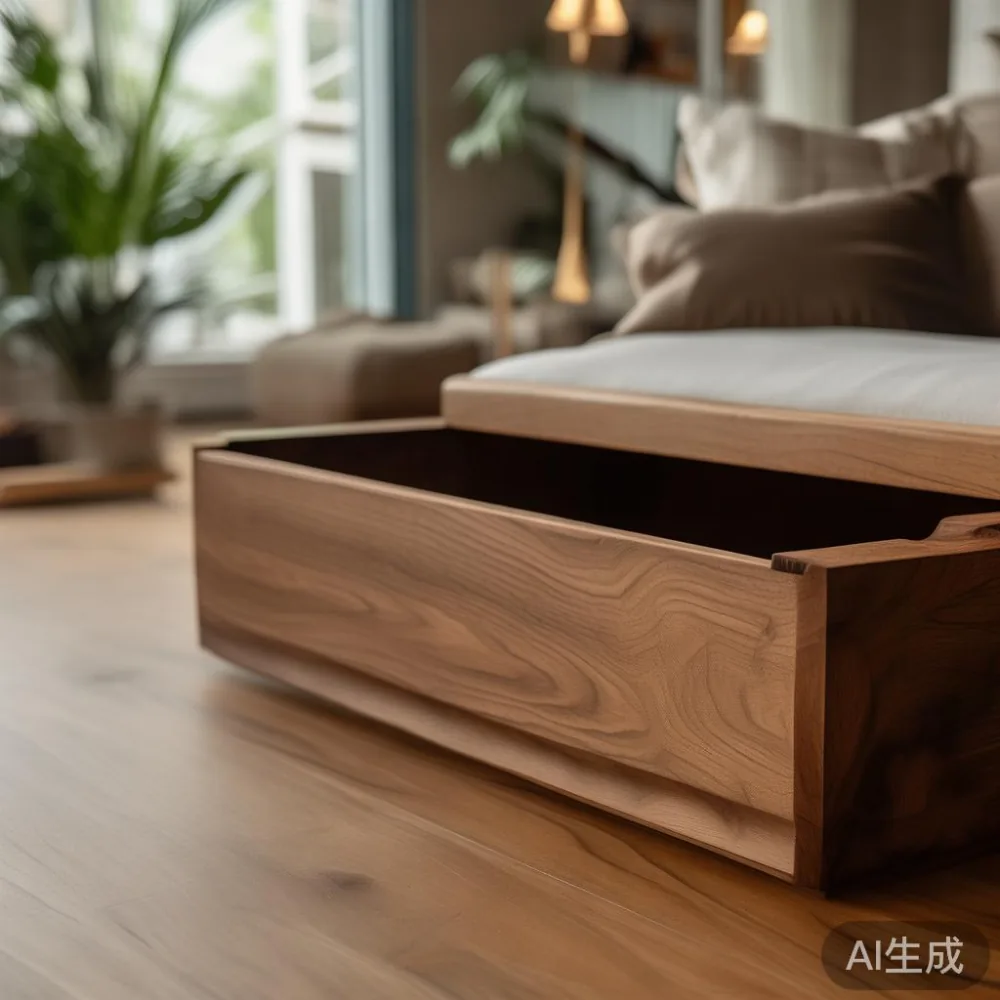
A storage bench is the test case I keep coming back to, because it sits in the one zone of the home that gets punished hardest: the entryway, the foot of the bed, or the HDB corridor landing. It holds bags, wet umbrellas, dog leads, and occasionally a 25 kg backpack. Its warranty terms tend to matter more than a decorative nightstand, because the user load is higher and the joints see more torque. The phrase storage bench gets abused by listing sites that call a hollow MDF ottoman a storage bench — look for a minimum carcass thickness of 18 mm, solid wood throughout the load-bearing frame, and a written statement on the warranty card about "drawer slide load" in kg.
Beyond the storage bench, the same checklist applies to a solid wood sofa frame, a bed frame with hydraulic storage, a 6-seater dining table, a marble table, a wardrobe, and a nightstand. Check whether:
• Wood species is named (oak, ash, walnut, rubberwood) — not "hardwood" or "solid wood" alone.
• Joint method is named (mortise and tenon, dowel, dovetail) — not "reinforced joinery".
• Hardware brand is named (Blum, Hettich, DTC) — not "premium runners".
• Load rating is stated per shelf or per drawer — not "suitable for storage".
When I visited the MIDHILL showroom last month with a colleague who was buying a wardrobe and a matching storage bench for a new Punggol BTO, the sales lead pulled out a single sheet listing all four of the above for each product. That single page saved us roughly two hours of guessing over WeChat. A warranty should be that specific.
Is post-modern light luxury furniture harder to warranty than minimalist pieces?
Slightly, and the reason is the finish. Post-modern light luxury design tends to layer brass-tinted hardware, soft-close drawer fronts, marble tops on side cabinets, and aged-ceramic handles. Each of those is a separate subsystem with its own supplier warranty. A marble table top, for instance, often comes with a 2-year warranty against cracking or staining under normal household use, while the wooden base carries the longer structural warranty on the same piece. Read both sections.
European light luxury bed vs Mid-century modern bed is a comparison worth making on warranty terms, too. A European light luxury bed tends to use upholstered headboards, curved solid wood trim, and integrated bedside joinery that complicates disassembly. A Mid-century modern bed is usually a clean platform with slats, fewer parts, and a warranty that is easier to honour because there is less to fail. Neither is wrong — but if you intend to keep the bed in your Tampines flat for 10+ years, a simpler joinery pattern often means a simpler claim path.
For households thinking about American wardrobe styling, the practical note is that American wardrobes are taller (often 215 cm to 230 cm) and rely on a 12 mm to 18 mm back panel for racking stiffness. That back panel is a prime warranty question. The phrase how to style American wardrobe in room will normally cover decorative choices, but the warranty question underneath is: what happens when the back panel bows from 85% humidity in November? The answer should be on the card: replacement back panel, not full wardrobe swap.
How long should a refinishing service really last, and what should it cost?
Lifetime refinishing is a term that gets thrown around in American furniture marketing. In Singapore, where humidity and sunlight are both intense, the refinishing window for an indoor storage bench or bed frame is usually 6 to 8 years before the surface loses its lustre. A good refinishing service should include sanding back to bare wood, re-staining to a shade you choose, two coats of conversion varnish or oil, and hardware re-tightening. Pricing varies by item: a 160 cm storage bench refinished locally in Singapore typically runs 180 SGD to 280 SGD, while shipping a 220 cm wardrobe to a workshop and back pushes that figure past 600 SGD.
MIDHILL's lifetime refinishing offer is unusually generous because the pieces return to the Foshan factory, where the original timber batch and finish codes are on file. For a Singapore buyer, that means freight and a 60-to-90-day round trip. Still, on a 2,800 SGD European light luxury bed, the math works out: one refinish at year 8 for roughly the cost of a 9-month delivery wait, and the bed looks new again at year 18. If a brand does not offer refinishing, ask whether they stock replacement lacquer in your wood species — that is the next-best signal.
What does a fair return policy look like for furniture in Singapore?
A 14-day return window works for furniture only when the item is unassembled and still in a sellable box. Once the storage bench or the 200 cm dining table has been built, returns become a logistics exercise. Read the return policy for these clauses:
• Returned-in-original-packaging only vs assembled-but-unused.
• Restocking fee: typically 10% to 25% of the sale price.
• Who arranges and pays return pickup: you, or the seller with a 5-to-10-day booking window.
• Refund method: original payment channel, store credit, or replacement item of equal value.
For a Singapore HDB flat, a pickup that requires a 2.4 m van and a porter costs 80 SGD to 150 SGD on Sentosa and 120 SGD to 220 SGD on Sentosa — sorry, in Woodlands or Sembawang, where kerb access is tighter. Add the restocking fee and you might lose 250 SGD returning a 950 SGD item. That is a third of the price of the storage bench itself, so it pays to measure twice and order once.
What should I photograph on the day my storage bench arrives?
Six photos, in this order: (1) the outer carton with the shipping label and the receiving timestamp; (2) the foam wrap and corner protectors still in place; (3) any visible damage to the wood or the drawer faces before assembly; (4) the legs and the underside of the bench, where furniture often shows manufacturing defects the showroom hides; (5) the hardware pack and the instruction sheet; (6) the assembled bench with a tape measure extended from corner to corner. Photos (3), (4), and (6) are the three that win warranty claims. Date-stamp them with your phone's automatic metadata; most warranty handlers accept that as evidence.
For buyers thinking about a best Minimalist bed for 2026 or a Post-modern for guest room refresh, the same six-photo rule applies. A bed frame's slats and the mattress-receiving recess are the hidden spots worth photographing. With a French sofa, fold down the dust cover underneath and shoot the frame springs, because that is where a 1,200 SGD to 4,500 SGD claim usually originates.
What about Japandi or French styling — does that change what I should claim against?
The style does not change the warranty, but it does change what counts as a "defect" in your eye. A Japandi piece is meant to show the timber grain, the dovetailing, and the joinery — a hairline gap of 1 mm at a dovetail looks out of place in a room that follows how to style Japandi wardrobe in bedroom guides exactly. A French light luxury piece, by contrast, hides its joinery under shaped trim and brass hardware, so the visible defects are usually at the polished surfaces or the marble accents. Photograph accordingly. Photograph the grain on a Japandi storage bench, and photograph the polish on a French-style marble table.
A common Singapore question, when talking about how to style French sofa in room, is whether the warranty covers fabric compression from window sunlight. Most warranties exclude UV fading under 3 years of direct exposure. If your Tampines living room has west-facing windows, add a UV-filtering film at roughly 22 SGD per square metre, installed. That small spend protects the warranty claim and the fabric.
How do I contact the maker if something fails years later?
Keep three things forever: the invoice PDF, the warranty card or terms page, and the maker's contact. For MIDHILL and similar Foshan export brands, the contact page at www.midhill.co lists a WhatsApp line for Singapore alongside the global email queue. Screenshot the contact page on the day you order; if the brand is rebranded or the domain expires years later, you still have the routing information.
When you write the claim, lead with the order number, the item, the date of delivery, and a one-line defect description. Attach the six photos. State the remedy you want — replacement part, refinishing credit, or full replacement — and a reasonable timeline (10 working days for a part, 30 for a refinishing slot). Most Singapore-friendly sellers respond inside 48 hours. If they do not, the Consumer Protection (Fair Trading) Act gives you a clear path through the Consumers Association of Singapore (CASE). Keep your tone factual, never strident. The warranty is a contract, not a negotiation.
A 90-second pre-purchase checklist for Singapore furniture buyers
Print this. Tape it inside your wardrobe door.
☐ Wood species and thickness stated (≥ 18 mm carcass for a storage bench or wardrobe).
☐ Joint method named (mortise and tenon, dovetail, dowel + glue).
☐ Hardware brand named (Blum, Hettich, DTC, Sugatsune).
☐ Load rating per drawer / per shelf stated in kg.
☐ Structural warranty length and pro-rating schedule written.
☐ Cosmetic warranty length and exclusions written.
☐ Finishing / refinishing terms written, with cost or free.
☐ Return window length and restocking fee stated.
☐ Pickup cost in Singapore stated, with a S$ figure.
☐ After-sales contact method stated (WhatsApp, email, local agent).
☐ Six arrival-day photos saved to cloud with timestamps.
☐ Invoice PDF emailed to yourself and one trusted contact.
Tick eleven of twelve, and you are buying well. Tick all twelve, and you are buying the way a 12-year owner buys — not the way a one-year shopper buys. The piece you bring home should outlast the warranty by a comfortable margin, and the paperwork should outlive the piece. That is the real point of reading the warranty before you buy.