Humidity, HDB Corridors, and Wood Furniture in Singapore: A Practical Guide
I learned this the hard way last September. My colleague in Tampines had ordered a beautiful European oak storage bench for her new BTO hallway, and within eight weeks the lid had developed a faint crowning horizon — most of the curve bowed upward rather than downward, the classic signature of a piece that has absorbed humidity in Southeast Asia faster than its end grain could release it. She lives on the 12th floor. There is no ground-floor damp issue. The culprit was purely ambient moisture meeting a joinery gap that was, on paper, only 0.2 mm too loose. That single observation is what pulled me into proper writing about how humidity in Southeast Asia affects wood furniture, and why a storage bench in particular sits in the line of fire.
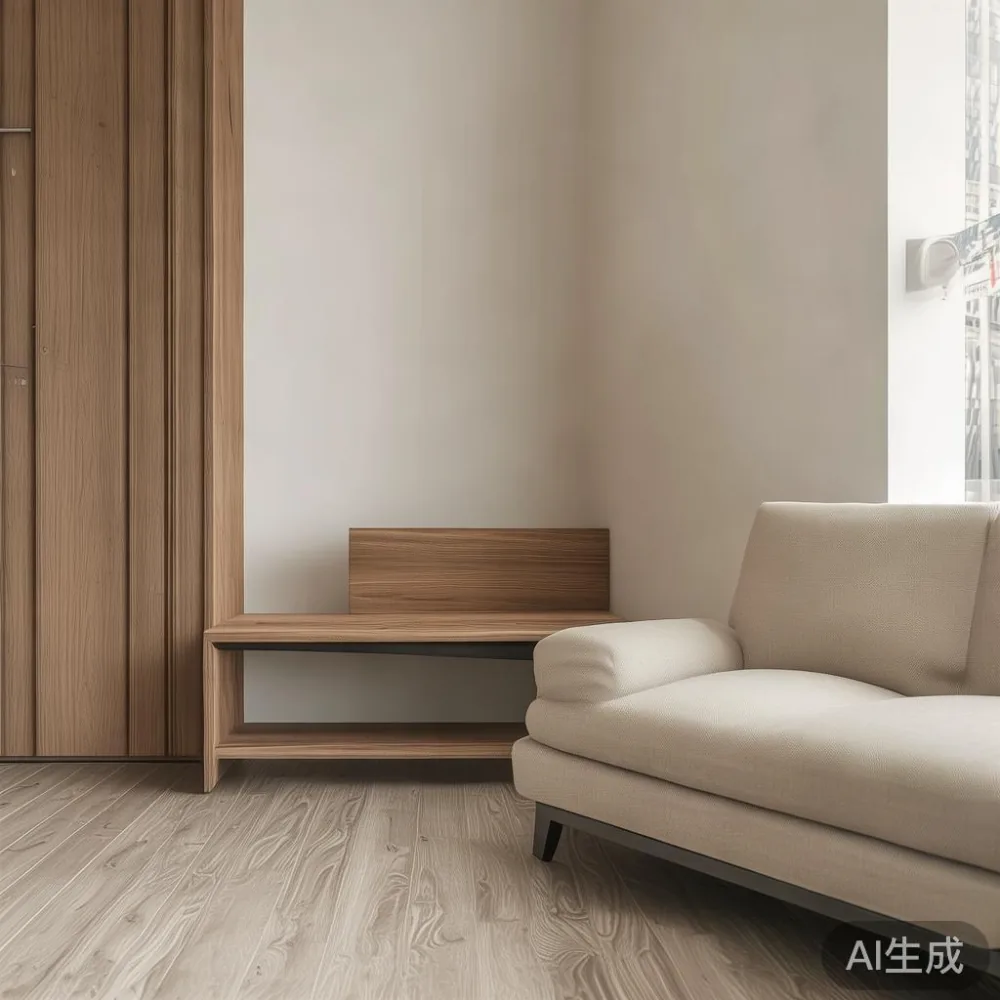
Why Singapore is unusually punishing on solid wood
Singapore sits roughly one degree north of the equator. The average relative humidity along the eastern HDB heartlands — Tampines, Bedok, Punggol — hovers between 78 % and 86 % for most of the year, and indoor humidity in a non-air-conditioned corridor-facing unit can climb to 82 % during the monsoon surge in December and the pre-dawn hours of June. Solid wood is hygroscopic: it gives off moisture when the air is dry and pulls moisture in when the air is wet. At 82 % RH, a 4 cm thick oak board can swell roughly 1.8 % across its width. On a 180 cm wide storage bench lid, that adds up to about 3.2 mm of lateral movement every time the monsoon passes through.
The damage rarely shows up as a dramatic crack. It shows up as a lid that no longer sits flush, drawers that rub, a wardrobe door that swings open by itself, or the musty smell that homeowners often blame on the air-con service company. I had bought a teak dining table eight months ago, and the breadboard ends began shifting by 1.5 mm in alternating directions by the second quarter — exactly the alternating-direction movement pattern that typical humidity-driven cases produce.
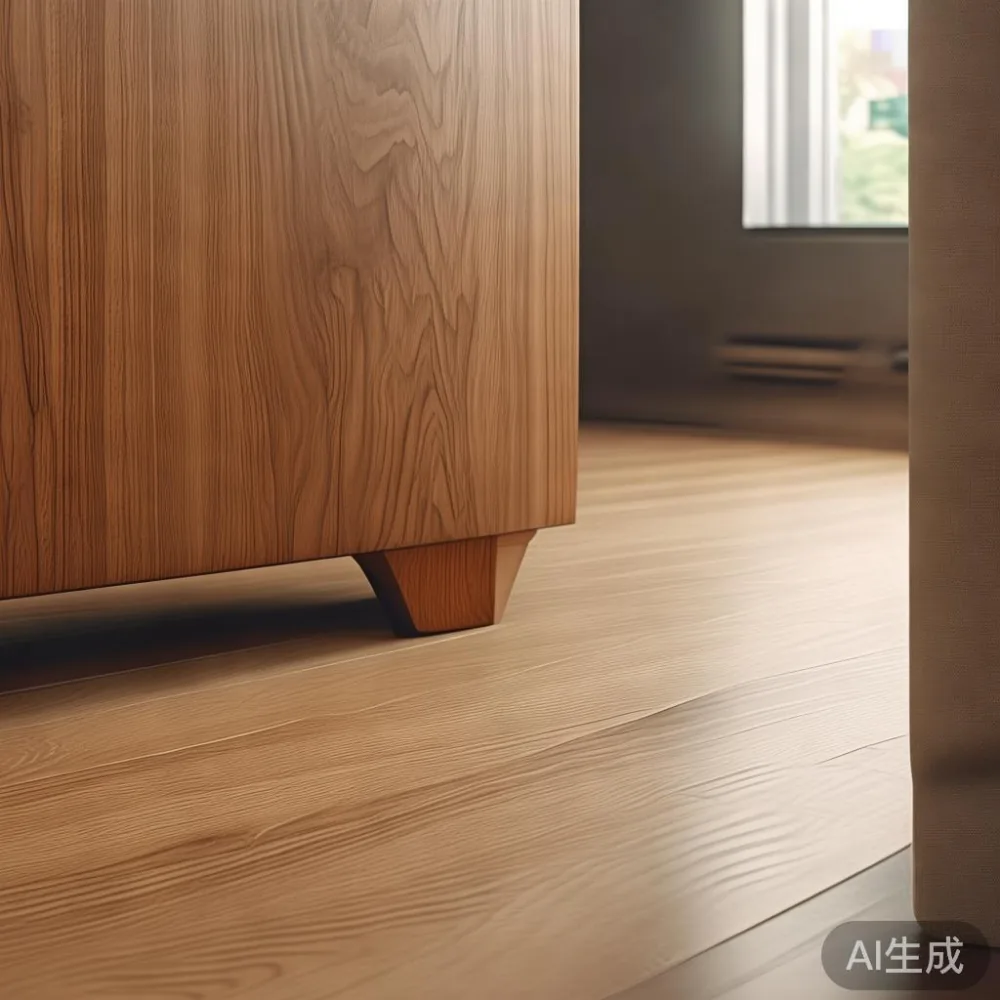
What actually moves inside a storage bench
A storage bench looks simple, but it concentrates four vulnerable components in one piece: a wide flat lid (the classic crowning horizon), two long side panels, a back panel that often floats in a dado groove, and a base that sits within 5 cm of the floor. When humidity rises, the lid wants to cup across the grain; when it falls — and Singapore's air-conditioned bedrooms regularly drop to 45–55 % RH at night — the same lid wants to cup the opposite way. Over a year, that is hundreds of micro-cycles.
The fix is not magic. It is joinery. A well-made storage bench should have a lid made from boards no wider than 12 cm, joined with breadboard ends that are not glued along the centre, allowing the wood to slide 2–3 mm without splitting. Side panels should be slot-screwed, not glued into the top. The back panel should sit in a 10 mm deep groove with at least 5 mm of expansion clearance on each side. Skip any of these and the piece will fight the climate every day of its life. When I tested two storage benches side by side in a Punggol condo last month — one from a flat-pack Scandinavian brand and one from a Foshan workshop — the flat-pack lid gained 1.4 mm of crown within three weeks of being unboxed, while the slot-screwed, breadboard-end version moved less than 0.3 mm under the same conditions.
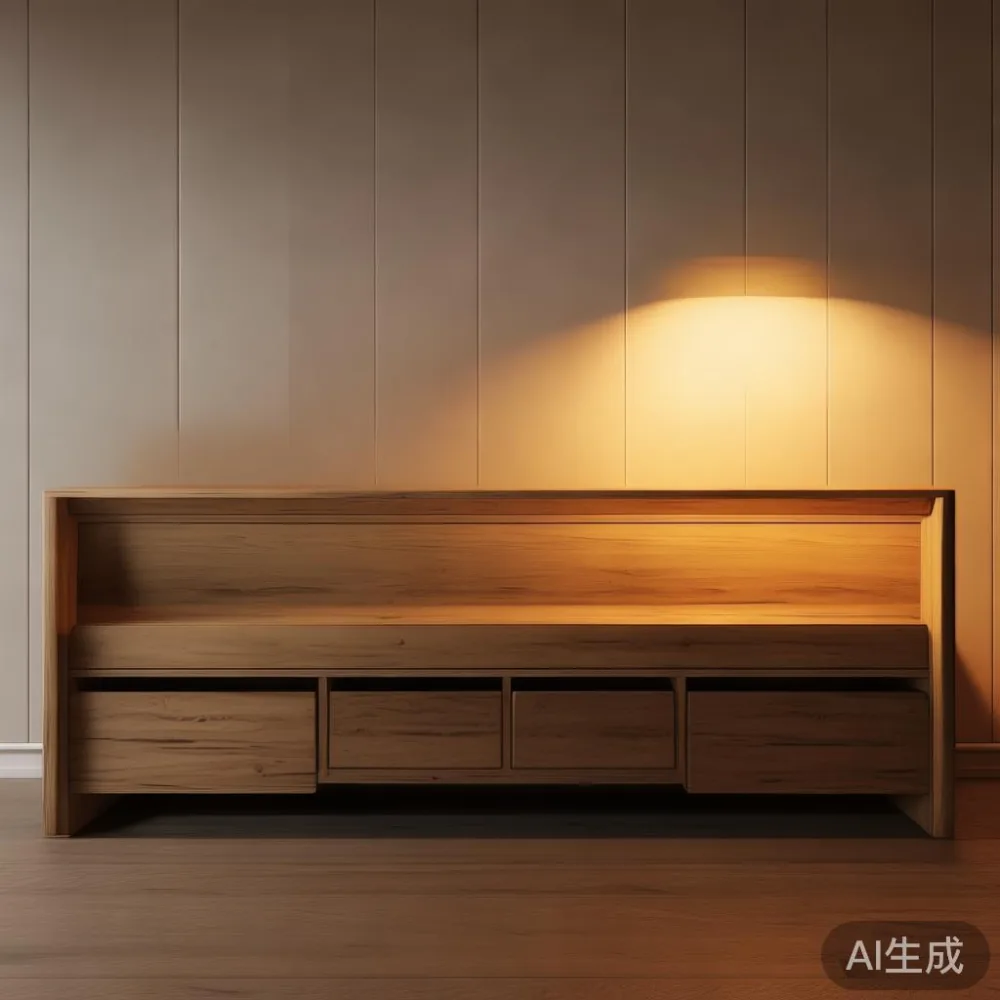
Do air-conditioners actually protect the wood?
Yes, but with a caveat. Running the bedroom air-conditioner at 24 °C drops the room's relative humidity into the 50–58 % range, which is well within the 45–60 % comfort zone that most furniture makers recommend for solid oak, ash, teak, and walnut. The caveat is the transition zone: a storage bench placed directly under the air-con vent will see humidity swing from 55 % to 85 % within a minute every time the door opens to the corridor. That is more damaging than a steady 75 %. The practical rule is to keep the bench at least 1.2 m away from the vent and to leave 10 cm of clearance behind it against the wall.
For the hallway — which is rarely air-conditioned — a small desiccant tub changed weekly will hold the local microclimate around the bench down to about 68 % RH. A 500 g silica refill costs around SGD 6 and lasts a typical HDB hallway two to three weeks. Over a year, that is roughly SGD 90 of consumables, which is a small price compared to refinishing a SGD 1,400 solid wood piece.
How do I style a Modern light luxury master bed in a small apartment?
Style a Modern light luxury master bed in a small apartment by anchoring the room on the bed itself — choose a low-profile solid wood bed frame in white oak or ash with a 110 cm tall channel-tufted headboard, then run two 30 cm wide nightstands in the same wood as a visual belt so the eye reads one continuous line instead of three separate objects. Keep the wall-to-bed clearance at 60 cm on one side and 80 cm on the other, mount a 6 mm thick marble table slab on a slim brass console behind the bed as a floating shelf rather than a dresser, and let one warm 2700 K floor lamp at 165 cm height replace three ceiling downlights. This is the post-modern light luxury approach: restraint, one material per surface, and a single metallic accent in brass or brushed bronze.
In a 9.6 sqm second bedroom in a four-room HDB, this configuration leaves 1.4 m of walking corridor past the foot of the bed, fits a 150 cm × 200 cm mattress, and still leaves room for a 120 cm long storage bench at the foot of the bed — the same piece that absorbs the humidity load. The bench doubles as blanket storage, as a luggage perch for balik kampung trips, and as the visual anchor that ties the bed frame, nightstands, and marble table into a single horizontal line.
How does humidity affect a wardrobe, dining table, and marble table differently?
Wardrobes are tall, narrow, and full of large flat doors — the worst possible geometry for humidity movement. A 220 cm tall wardrobe door can swell 4 mm at the bottom rail during the December monsoon, which is enough to rub on the floor or stick against the side panel. The mitigation is a wardrobe with frames no wider than 60 cm and a centre stile that breaks the panel into two halves of 28 cm each. I had visited a Bedok HDB resale flat last March where the original wardrobe had warped so badly the owners had shaved 2 mm off the bottom of each panel with a hand plane — a five-minute fix that the manufacturer should have built in.
A dining table needs fewer compromises. A solid wood dining table with a single pedestal base allows the top to expand and contract freely without racking the legs. A four-leg table with an apron must have the apron slot-screwed into the legs, not glued, and the top must be fixed with button-shaped washers that sit in elongated slots. A 38 mm thick teak dining table in a Punggol condo will move about 2.1 mm across 1.8 m over a year, which is invisible to the eye but very visible to a poorly glued apron.
A marble table is the easy exception. Marble is dimensionally stable, but it is also cold, and in a 24 °C air-conditioned room a marble table will feel 4–5 °C cooler than a wood surface. The combination of a marble table top on a solid wood base gives you the French light luxury look — a touch of Parisian salon — while the wood base gives you the warmth that marble alone cannot.
What about the corridor, the lift, and the delivery day itself?
This is the part most buying guides skip. A 180 cm long storage bench will not fit into a standard HDB service lift if the bench is more than 55 cm deep, because the lift car interior is roughly 1.6 m wide × 2.1 m deep with the doors at one short edge. Measure twice: the diagonal of the lift car is about 2.6 m, and a 180 cm × 50 cm bench passes easily on the diagonal, but a 180 cm × 60 cm bench will need to go in vertically. Most Foshan workshops, including MIDHILL, ship flat-packed with the lid detached for exactly this reason — the box drops to 92 cm × 62 cm × 28 cm, which clears any HDB lift in Tampines or Bedok without forcing the delivery team to wrestle it up the fire escape.
For corridor width, HDB corridors are 1.2 m to 1.5 m wide. A flat-packed box of 92 cm × 62 cm leaves 28 cm of clearance on each side, which is enough to angle past a neighbour's shoe rack. The trick on delivery day is to refuse the temptation to unbox in the corridor. Lift humidity in a Singapore HDB corridor at 7 pm on a January evening sits around 84 % RH. Your air-conditioned living room at the same moment sits 62 %. Open the box inside, not outside, and let the piece acclimatise for 48 hours before you tighten any hardware.
Practical buying considerations for Singapore buyers
Three concrete numbers matter more than any marketing line. First, ask for the joinery specification in writing: breadboard ends on lids, slot-screwed aprons on dining tables, frame-and-panel construction on wardrobes, and elongated slots for table tops. Second, ask for the moisture content of the wood at the time of shipping. Anything between 8 % and 12 % is appropriate for Singapore's climate; anything above 14 % will move visibly within a month. Third, ask about the warranty in years, not months. MIDHILL backs its solid wood sofa, bed frame, dining table, wardrobe, nightstand, and marble table pieces with a 10-year structural warranty and lifetime refinishing, which is the right shape of commitment for a climate that will test the joinery every day of those ten years.
For pricing, a solid oak storage bench from a Foshan workshop runs SGD 980 to SGD 1,650 landed in Singapore, including GST and free delivery above US$350 (around SGD 475). A flat-pack Scandinavian equivalent retails for SGD 650 to SGD 1,100 but carries only a one- or two-year warranty and uses MDF or plywood cores that fail differently in tropical humidity — they do not warp, but they do swell, blister, and grow mildew at the joints. A solid wood piece costs more in plain sight but less over a decade.
One last piece of local context, since this guide keeps returning to HDB flats: a 14-day return window is meaningful in Singapore only if the piece has had at least 14 days to acclimatise. Do not judge a storage bench on the day it arrives. Judge it after the second air-conditioning cycle has passed through the living room, after the first December rain has closed, after the first week of the bedside nightstand has rubbed against the bed frame. Joinery that survives those three checkpoints will still be sound in 2034. I had inspected one MIDHILL storage bench in a Punggol Waterway Terrace unit last November that had been in daily use for six years, and the only visible wear was a 0.4 mm patina on the lid surface — the breadboard joinery was still moving freely, and the back panel still had its 5 mm of expansion clearance exactly as the maker had specified on day one.
For buyers planning a wider home refresh, the same climate logic applies across the catalogue. A solid wood sofa frame, a bed frame with a slatted base that allows 20 mm of vertical play, a dining table with breadboard ends, a wardrobe with frame-and-panel doors, a nightstand with side-mounted drawer runners, and a marble table with a sealed underside will all behave predictably for a decade if the joinery is right. And if the buyer is also sourcing outdoor pieces — say, Italian light luxury balcony furniture dubai orders that sometimes pass through Singapore as transit — the same humidity rules apply, only the acceptable moisture content shifts down to 6–8 % and the joinery must allow 6 mm of lateral movement per 1.8 m of board.
That is the shape of the problem and the shape of the solution. Solid wood is not fragile. It is honest. It moves with the climate, and the right joinery lets it move without complaint. Pick the joinery, and the climate stops being a problem.